
CMHC MLI Select Explained: Points, Tiers & How to Qualify in Nova Scotia
If you're buying or building multi-unit residential (5+ units) in Nova Scotia, CMHC's MLI Select program is often the single biggest lever on your deal — up to 95% leverage and 50-year amortizations in exchange for commitments on affordability, energy efficiency, or accessibility. It's also widely misunderstood, and files fail on avoidable details. Here's how the program actually works, with the current parameters.
General information from the Indi Mortgage Commercial Division team — not financial advice. Program parameters below were confirmed against CMHC's published criteria in July 2026; CMHC revises them over time.
What MLI Select is
MLI Select is a mortgage loan insurance program from CMHC for multi-unit residential properties. Because CMHC insures the loan, lenders take on less risk — and they pass that back to you as higher leverage, longer amortizations, and better pricing than conventional multi-unit financing.
Who and what qualifies
- Buildings with 5+ residential units (retirement homes need 50+ units/beds). Standard rentals, single-room occupancies, supportive housing, and student housing all have paths in.
- Both existing buildings and new construction qualify — with different affordability thresholds (below).
- Mixed-use works — non-residential space is capped at 30% of floor area and 30% of lending value, so a building with ground-floor retail can still qualify.
The points system
You need at least 50 points across three categories, and more points unlock better terms.
Affordability (minimum 10-year commitment, rents at or below 30% of median renter income for the market):
| Points | Existing building | New construction |
|---|---|---|
| 50 | 40% of units affordable | 10% of units affordable |
| 70 | 60% of units | 15% of units |
| 100 | 80% of units | 25% of units |
A 20+ year affordability commitment adds a 30-point bonus.
Energy efficiency (20 / 35 / 50 points): existing buildings score by cutting consumption 15% / 25% / 40% versus current performance; new builds score against the 2020 national energy codes. Note: solar panels are capped at 15% of the claimed reduction and can't be your only measure — the building envelope and systems have to do the work.
Accessibility (20 / 30 points): all tiers require fully "visitable" units and barrier-free common areas; higher scores come from accessible or universal-design unit percentages or Rick Hansen certification.
What the tiers unlock
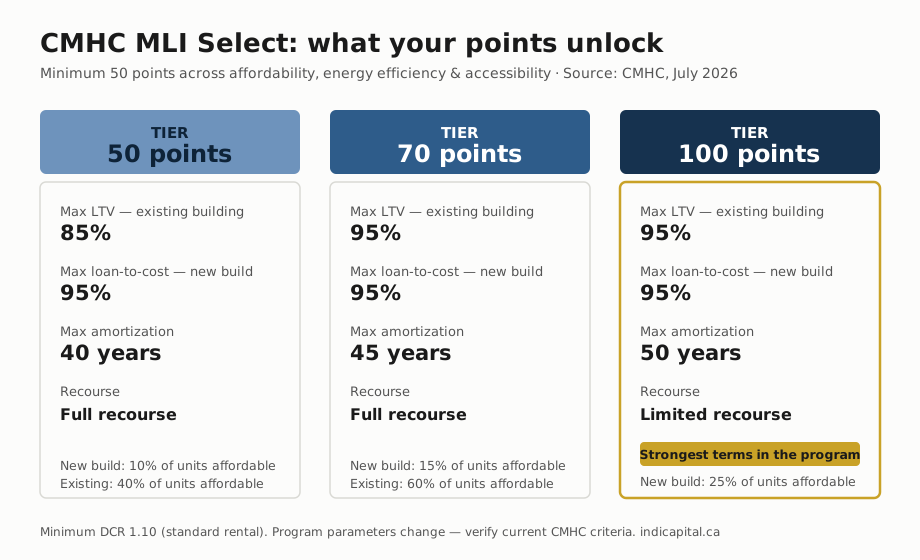
| 50 points | 70 points | 100 points | |
|---|---|---|---|
| Max LTV (existing) | 85% | 95% | 95% |
| Max loan-to-cost (new build) | 95% | 95% | 95% |
| Max amortization | 40 yrs | 45 yrs | 50 yrs |
| Recourse | Full | Full | Limited recourse |
Minimum debt coverage is 1.10 for standard rental (higher for supportive housing and non-residential components), and CMHC insurance premium discounts scale with points as well.
The parts people get wrong
- "Affordable" is defined by CMHC's median renter income tables for your market — not by what feels affordable. The qualifying rents differ across Nova Scotia communities.
- New construction needs only 10% affordable units to reach 50 points — a far lower bar than most investors assume. Those rents are then committed for 10 years, with CPI-linked increase limits.
- The energy documentation rules are changing: attestations against the older 2017/2015 energy codes are only accepted until September 30, 2026. Projects in planning now should confirm which code year their energy modeling uses — before application, not at it.
- Debt coverage kills more files than points do. The leverage caps are one thing; the building's income still has to carry the debt at the qualifying rate. Model it first with the commercial mortgage feasibility calculator.
- MLI Select is not the ACLP. CMHC's Apartment Construction Loan Program is a separate direct lending program for new rental construction ($1M minimum loan). Some projects use ACLP for the build and MLI Select-insured financing as the takeout.
Why it matters in Halifax
Halifax's rental market is tight, and construction and acquisition costs are high. MLI Select's higher leverage and long amortization can turn a deal that fails on conventional terms into one that pencils — especially for developers adding new supply, where the affordability and energy points often line up naturally with what you're already building.
What it costs and what to weigh
MLI Select isn't free leverage. Weigh the CMHC premium (added to the loan) and application fee, the multi-year commitments that run with the financing, and a longer, more documentation-heavy approval than conventional. For most multi-unit investors and developers, the improved leverage, amortization, and rate more than offset the premium — but the right call depends on your hold period and plans for the asset.
Does your project qualify?
The building generally needs to be 5+ residential units, and the deal has to clear CMHC's underwriting on the property's income and your covenant. The practical first step is to model the numbers and map which point combination — affordability, energy, accessibility, or a mix — gives you the best result. That's a design decision with six-figure consequences, and it's exactly the work we do before a file ever goes to CMHC.
Next steps
- Model your multi-unit deal: commercial mortgage feasibility calculator (includes CMHC scenarios)
- See which MLI Select tier fits: talk to our Halifax commercial team at (902) 298-0218
- Related: Apartment building financing in Nova Scotia · CMHC vs. conventional financing · Takeout mortgages
Sources
- CMHC — Multi-unit mortgage loan insurance (incl. MLI Select) — official program page, point tiers, and criteria
Indi Mortgage Commercial Division — CMHC MLI Select, multifamily, and construction financing across Halifax and Nova Scotia. General information only; program details are set by CMHC and change over time. Not financial advice.